accessiblewithdesign.com favicon

Independence, designed in Accessible With Design

accessiblewithdesign.com

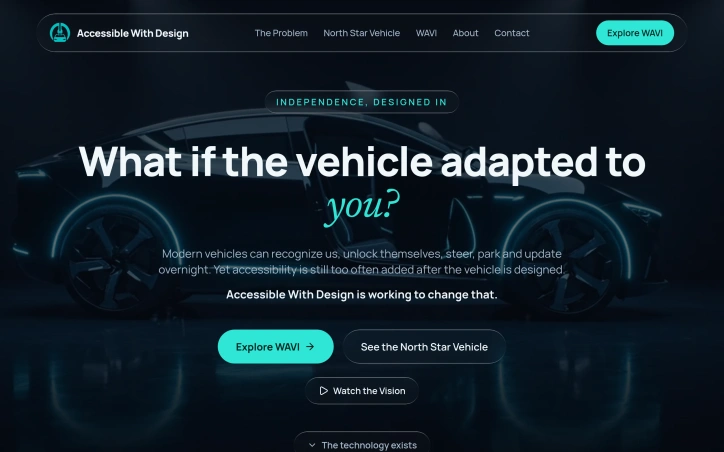
Accessible With Design is a New Mexico initiative applying vehicle design, robotics, AI and driving automation to transportation independence, and home of the WAVI index.

Video Review
0:00 / 0:00

About

Independence, designed in Accessible With Design

The technology for automated vehicle assistance already exists, but Accessible With Design argues that integration for people with limited mobility has lagged behind. This New Mexico initiative applies vehicle design, robotics, AI, and driving automation to transportation independence, centering its work on the premise that accessibility should be an engineering requirement from the start rather than an aftermarket addition. The project frames independence as a complete journey of nine linked actions: vehicle recognition on approach, automatic door opening, suspension lowering by three to four inches, seat rotation toward the door, seat extension outward beyond the sill, powered loading of a folding mobility scooter or device, automatic door closure, advanced highway driving assistance, and automated parking with summon capability. Each step uses technology that exists in current vehicles but is rarely designed as a coordinated chain. If one link fails, independence can fail with it. At the center of the initiative is the World Accessible Vehicle Index, or WAVI, which evaluates vehicles using criteria that traditional automotive reviews do not address. Instead of measuring horsepower or acceleration, WAVI asks whether a mobility device can come along, whether the vehicle reduces the physical effort of driving, whether it can be adapted safely, and whether automation can increase independence. The scoring model applies explicit weights across five categories: Mobility Device Compatibility accounts for twenty percent, Driving Accessibility and Assistance & Automation each carry fifteen percent, Comfort & Fatigue Reduction represents ten percent, and Ownership & Support holds five percent. Every index entry displays three separate scores from zero to one hundred alongside a visible data confidence level. The project was founded from lived experience and engineering curiosity, designed in New Mexico to address what it describes as a global problem. Sample entries include a minivan and a full-size accessible van, with scores covering what the vehicle provides today, what can be added through qualified modification, and how emerging automation may increase independence.

Updated 9/9/2026

Key Features

World Accessible Vehicle Index

A scoring system that evaluates vehicles across five categories including mobility device compatibility, driving accessibility, automation assistance, comfort reduction, and ownership support using weighted criteria from zero to one hundred.

Nine-Step Independence Chain

A coordinated sequence covering vehicle recognition, automatic door opening, suspension lowering by three to four inches, seat rotation and extension, mobility device loading, door closure, highway driving assistance, and automated parking with summon capability.

Mobility Device Compatibility Scoring

Assessment of whether a vehicle can accommodate folding mobility scooters or other assistive devices as part of the complete journey, weighted at twenty percent of the overall index score.

Three-Tier Evaluation Model

Each vehicle receives separate scores for current factory capabilities, potential through qualified modifications, and future possibilities with emerging automation technology.

Data Confidence Transparency

Every index entry displays visible confidence levels alongside the three scored categories to indicate the reliability of the assessment.

Use Cases

01
People with limited mobility seeking transportation independenceThe initiative addresses the gap in vehicle design by evaluating whether existing automation and robotics can be integrated into a complete accessible journey rather than added as aftermarket modifications.
02
Vehicle buyers researching accessibility featuresWAVI provides criteria-based scoring across mobility device compatibility, driving effort reduction, and automation assistance that traditional automotive reviews do not measure.
03
Engineers and designers developing accessible vehiclesThe project demonstrates how existing technologies like automatic doors, adjustable suspension, rotating seats, and parking automation can be coordinated into a unified accessibility system where each link supports the complete chain of independence.

Ratings & reviews

No reviews yet. Be the first!