quelltest.com favicon

Quelltest: the free, offline gate for AI-written tests

quelltest.com

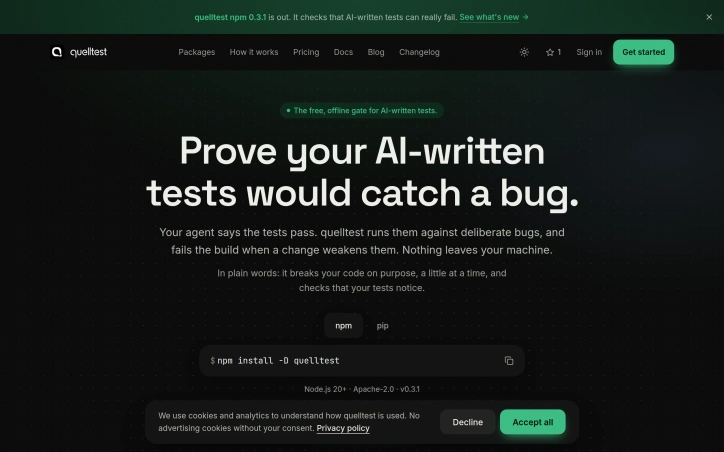
Free, offline gate for AI-written tests. Prove tests would fail if the code were wrong, catch weakened tests in a change, and generate verified pytest tests for Python.

Video Review
0:00 / 0:00

About

Quelltest: the free, offline gate for AI-written tests

AI-generated tests often pass without truly validating the underlying code. Quelltest addresses this problem by deliberately breaking code to verify that tests can actually detect bugs. The tool operates entirely offline and locally, ensuring that no code leaves the developer's machine. The verification process works by creating throwaway copies of the codebase and introducing small, deliberate bugs called mutants. When a test still passes despite these intentional defects, it reveals that the test was never genuinely protecting that code. This approach exposes weak assertions, untested edge cases, and gaps in test coverage that traditional green checks miss. Quelltest provides three primary commands. The "verify" function plants deliberate bugs and confirms tests fail appropriately. The "find" function identifies risky, untested spots in the codebase, prioritizing areas where bugs commonly hide such as guards, fallbacks, and thrown errors. The "gate" function compares tests against a previous version and fails the build when tests have been deleted, skipped, or weakened—preventing developers or AI agents from inadvertently reducing test quality. The tool supports JavaScript and TypeScript through an npm package compatible with Jest, Vitest, Mocha, and node:test on Node.js 20 and above. A Python version is available for Python 3.11 and higher. Both packages include MCP server integration, allowing AI coding agents in Claude Code, Cursor, and other MCP clients to run these checks on their own generated tests. Agents cannot mark work as complete until quelltest validates the tests meet quality standards. Quelltest is free and released under open-source licenses—Apache-2.0 for the npm package and MIT for Python. The tool requires no external services or network connectivity. According to the documentation, it found 11 of 18 known defects reported against a real codebase with zero false alarms on seven clean files, and rejected seven of seven weak tests at the recommended 60% threshold.

Updated 10/22/2026

Key Features

Mutation Testing

Deliberately introduces bugs into code copies to verify that tests actually detect defects rather than just passing superficially.

Offline Local Operation

Runs entirely on the developer's machine without sending code to external services or requiring network connectivity.

Test Quality Gates

Compares current tests against previous versions and fails builds when tests are deleted, skipped, or weakened.

Risk-Based Analysis

Identifies untested code areas that are statistically prone to bugs, such as guards, fallbacks, and error handling paths.

Multi-Language Support

Available for JavaScript, TypeScript, and Python with compatibility across major testing frameworks including Jest, Vitest, Mocha, and node:test.

AI Agent Integration

Provides MCP server integration that enables AI coding agents to validate their own generated tests before marking work complete.

Use Cases

01
Developers using AI-generated tests — Ensures that AI-created tests genuinely validate code behavior rather than producing false confidence with superficial green checks.
02
Teams enforcing test quality standards — Prevents degradation of test suites by automatically failing builds when tests are removed or weakened during code changes.
03
Projects requiring verified test coverage — Identifies weak assertions and untested edge cases that traditional coverage metrics miss, revealing gaps in actual defect detection.
04
Security-conscious development teams — Operates entirely offline and locally, ensuring sensitive codebases never leave the developer's machine during testing validation.

Ratings & reviews

No reviews yet. Be the first!