About
Should We Live Together?
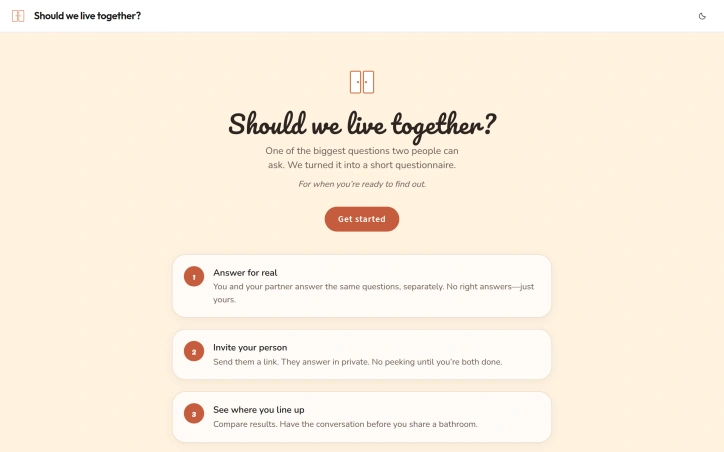
Couples who are seriously considering moving in together finally have a structured way to get on the same page before the moving boxes appear. Should We Live Together walks two partners through a short questionnaire designed to surface the conversations that matter — the ones that often get skipped in the excitement of a new chapter.
The process is straightforward and built around honesty. Each partner answers the same set of questions independently, without seeing the other's responses in real time. There are no right answers built into the questionnaire; the point is simply that each person answers truthfully for themselves. Once one partner completes their responses, they send a link to the other. The second partner then answers privately, with no ability to peek at what their partner said. Only after both people have finished do the results become visible together.
That reveal is the core of the experience. The comparison view shows where the two partners line up — and where they do not. The goal is not to produce a pass or fail verdict on the relationship, but to give couples concrete, specific material for a real conversation. Moving in together involves an enormous number of practical and emotional adjustments: shared finances, differing sleep schedules, cleanliness standards, alone time, guests, routines. Discovering a mismatch on the couch before discovering it in person is precisely the kind of friction the tool is designed to prevent.
The entire experience is designed to be low-friction and accessible. No account creation is required. The questionnaire runs on a phone and takes only a few minutes to complete. There is no lengthy onboarding, no profile to fill out, and no subscription to manage. The simplicity is intentional — the hard part is not the technology, it is the conversation, and the tool stays out of the way so that conversation can actually happen.
Should We Live Together is built for couples at a real inflection point: people who are past the early dating stage, who care about each other, and who are starting to ask whether sharing a home is the right next step. It is not a compatibility test in the abstract sense, and it does not promise to predict whether a relationship will succeed. What it does is create a shared, structured moment for two people to be honest — separately first, then together — about something that genuinely matters.
The experience strips away the awkwardness of raising certain topics cold. Instead of one partner nervously bringing up how they feel about overnight guests or how they handle money, both partners have already answered the same questions in the same format. The comparison becomes the entry point for the conversation, not a confrontation. That framing — answering the same questions, separately, then comparing — is what makes the tool useful for couples who want to move forward thoughtfully rather than impulsively.
Updated 4/18/2026